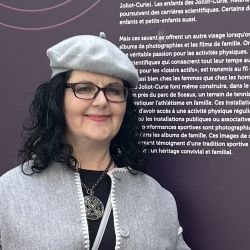
Ornela Piluri: Showing the Hidden Beauty of the Micro World
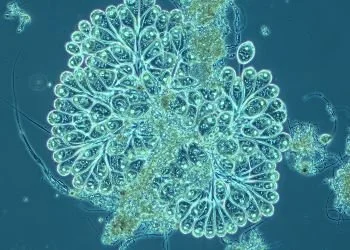
Stalked Ciliates
Ornela Piluri is the chief microbiologist at Upper Blackstone Clean Water, the wastewater treatment facility serving Worcester, Massachusetts and the surrounding communities. It is there where she monitors the health of the microorganism population that treats thirty-million gallons of domestic and industrial wastewater each day. These microorganisms, which naturally occur in soil, are inoculated into the wastewater process creating, in simple terms, a giant liquid compost pile. Under the right conditions, such as specific dissolved oxygen levels, food to microorganism ratios and adequate nutrients, these microorganisms play a key role in recycling dirty water into clean water before releasing it back into the environment.
I recently had the honor to chat with Ornela about her photos and the passion she shows through them. Not only does she know the technical aspects of using an advanced phased contrast microscope and associated camera equipment for documenting changes in daily micro life health, but Ornela has also brought these images to an art form.
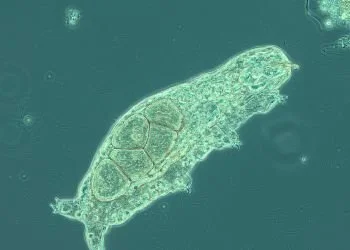
Tardigrade, commonly called a “Water Bear,” is a tiny animal made up of about 1000 cells. The length of an average adult tardigrade is about the width of two human hairs.
Tim: I sense a passion in your photos of micro life. Do you see something more in these than just a bunch of “bugs” under a microscope?
Note: In the wastewater field, anything viewed under a microscope is often referred to as a “bug,” even though, technically, none of them are bugs in the traditional sense.
Ornela: What drives me is curiosity and a sense of wonder. When I look through a microscope, I don't just see bugs, I see amazing details, patterns, and structures that are normally hidden from view. What really interests me is discovering and sharing this tiny world with others. Even the smallest creatures can be surprisingly beautiful and complex when you look at them closely. So yes, I do see more than just bugs. I see a hidden part of nature that most people never get to experience, and I enjoy showing that beauty through my photographs.
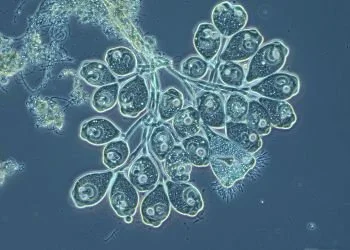
Stalked Ciliates with a single Suctorian. Depending on the species, it would take between 300 and 800 individual ciliates lined up end to end to reach one inch.
Tim: You mentioned to me in the past that one of your science icons is Marie Curie. What is it about her that has influenced you? What does her life tell you?
Ornela: I first learned about Marie Curie when I was 13 years old. I found an old biography of her on my father’s bookshelf in our home in a small village in Albania. Marie Curie and her husband shared a Nobel Prize in Physics in 1903 for their work in radioactivity. She won another Nobel Prize in 1911, this time in Chemistry, for her discoveries of the elements radium and polonium.
I remember becoming completely absorbed in the book. It was also my first real connection to chemistry, and it sparked something in me. At that time, I felt a strong connection to her story. Her curiosity and determination inspired me, and I started to dream about becoming a scientist myself. Years later, during a visit to Paris, France, I visited a museum dedicated to her life and work. Standing there felt very meaningful, like a dream coming true. Her story continues to inspire me to stay curious, work hard, and keep exploring the world around me.
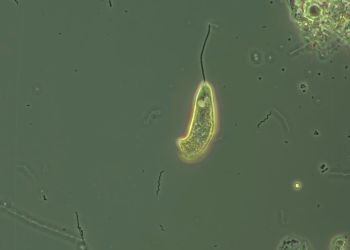
This Euglena is a single cell flagellate, its one waving tail propels it through the water. The small corkscrew-looking bacteria in this image are Spirochetes. Depending on the species of Spirochete, up to 5000 end to end will reach an inch in length. The tiny dots in this image are small bacteria, a chain of up to 25,000 would be an inch long.
Tim: What do you hope others will see when they look at your photos?
Ornela: I hope people see more than just a magnified microorganism. I hope they see the beauty, complexity, and wonder that exists in even the smallest forms of life. For me, they are a reminder that nature is full of incredible detail and creativity.
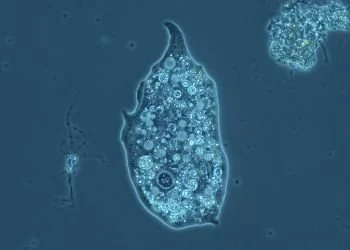
Amoebas are a formless single-cell organism. You can see in the photo the false feet forming (the pointed parts at the 12 and 9 o’clock positions). These help in mobility and in capturing food.
Tim: At the end of the day, how do you see yourself making the world better by what you do?
Ornela: I hope my work helps people appreciate nature a little more. When people see beauty and detail in even the smallest living things, they may become more aware of the world around them. If my photos encourage someone to be curious, to look closer, or to care more about the environment, then I feel I've made a positive difference.